Cregan Stark's executions
Fire & BloodCregan Stark’s executions were the decisive act of his brief service as Hand: a mass sentence at the Red Keep that ended with only two men dead, as nearly all the condemned secured a reprieve by joining the Night’s Watch. The scene placed Northern law and the condemned men’s desperate appeals against the expectation of a sweeping royal reckoning. It also brought Lord Larys Strong’s life, and the history of his house, to an end.
The sentence and its setting
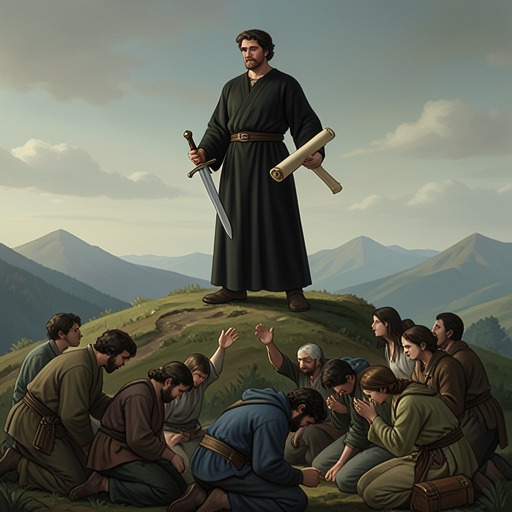
The condemned were brought in chains from the dungeons to the Red Keep’s outer ward on a grey, wet morning. They were made to kneel while Prince Aegon and his court watched. Septon Eustace led them in prayer, asking the Mother to show mercy. The rain continued through the long service, delaying the executions and making the prisoners’ exposure part of the scene without changing the sentence that awaited them.
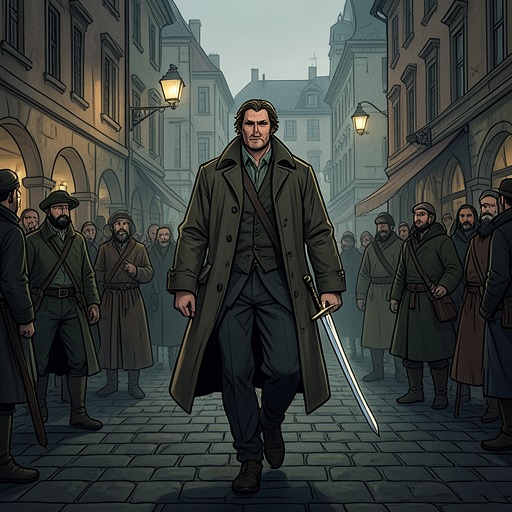
When the prayer ended, Cregan drew Ice, the Valyrian greatsword prized by House Stark. The account explains that Northern custom required the person who passed sentence to wield the sword himself, placing responsibility for the condemned men’s deaths directly upon the sentencing lord. Cregan therefore did not delegate the task to a headsman. The scale of the sentence made the morning an exceptional burden even for a high lord accustomed to the demands of justice.
A way out through the Night’s Watch
The condemned had drawn lots to determine who would die first, and Ser Perkin the Flea was selected. Asked whether he had any last words, Perkin requested to take the black. Cregan accepted the request and ordered his men to raise him from his knees. That decision changed the possibilities for the other prisoners: one by one, they asked for the same reprieve rather than face execution.
Their appeal spread through a varied group of prisoners. It included gutter knights and men-at-arms, household servants, litter-bearers, heralds, and the keeper of the wine cellars. Three members of the Kingsguard also asked to exchange their white cloaks for black. Grand Maester Orwyle joined them. His case demonstrated that service to the Night’s Watch was not limited to men who could fight; the Watch also needed men able to use a quill. The mass request turned the execution into a moment of collective survival, but only because Cregan recognized taking the black as a valid alternative and the Watch had need of recruits.
The two who died
Ser Gyles Belgrave was the first of the two men who did not accept that alternative. A Kingsguard knight, he refused to exchange his white cloak for the black and maintained that a knight of the Kingsguard should not outlive his king. Cregan killed him with a single stroke of Ice. His refusal distinguished him from the three other white-cloaked prisoners, who had sought the Watch instead.
Lord Larys Strong was the last to die. He too declined the black, but asked Cregan for one final concession: that his clubfoot be separated from his remains after death. Cregan granted the request. Larys’s remains were entrusted to the Silent Sisters, and his bones were eventually laid to rest at Harrenhal. His clubfoot, however, was to be buried separately in a pauper’s field and disappeared before that could happen. Mushroom’s account claims it was stolen and sold to a sorcerer for use in spells, while the history notes that a similar tale about Prince Joffrey’s foot makes the story’s truth uncertain.
Aftermath and significance
The heads of Larys and Gyles were mounted on opposite sides of the Red Keep’s gates. The surviving condemned returned to their cells while arrangements were made to send them to the Wall. Thus the original sentence produced two deaths, a public display of the two men who refused reprieve, and the transfer of the remaining prisoners into the Night’s Watch. Larys’s death also ended House Strong, described as an ancient and proud house.
The executions supplied the final line in the history of Aegon II’s troubled reign. Cregan’s own tenure as Hand ended the following day: he returned his chain of office to Prince Aegon and went back to Winterfell, saying that the snows were falling in the North and that his place was there. His departure closed the episode as firmly as the executions had closed the reign. The event’s outcome rested not only on the sentence but on the alternatives Cregan honored: Northern custom made him personally responsible for carrying it out, while the Night’s Watch’s need for men allowed nearly all the condemned to escape death by joining its ranks.